


The mobile app development industry is evolving faster than ever, driven by emerging technologies, cross-platform frameworks, and rising user expectations. As businesses strive to deliver seamless digital experiences across multiple platforms, developers with versatile and future-ready skills are in high demand. In this rapidly changing landscape, Flutter has emerged as one of the most powerful and popular frameworks for mobile app development. Enrolling in a Flutter app development course can equip developers with the expertise needed to build high-quality, cross-platform apps efficiently and stay ahead in the competitive market.
As we move into a new era of digital transformation, many aspiring developers and working professionals are asking an important question: Why choose a Flutter app development course in 2026? The answer lies in Flutter’s growing adoption, strong backing by Google, impressive performance, and exceptional career opportunities.
This in-depth guide explores why enrolling in a Flutter app development course in 2026 can be a smart career move, covering market trends, technical advantages, job prospects, learning benefits, and future potential.
Understanding Flutter and Its Growing Popularity
What Is Flutter?
Flutter is an open-source UI software development kit (SDK) developed by Google that enables developers to build natively compiled applications for mobile, web, desktop, and embedded devices from a single codebase. It uses the Dart programming language, which is optimized for high performance and rapid development.
Since its launch, Flutter has gained massive popularity due to its ability to deliver fast, visually rich, and high-performance applications.
Why Flutter Continues to Rise in 2026?
By 2026, Flutter is no longer just an emerging technology—it is a mainstream development framework. Leading companies, startups, and enterprises continue to adopt Flutter to reduce development costs, speed up time-to-market, and maintain consistent UI across platforms.
Key reasons behind Flutter’s growing popularity include:
- Strong support from Google
- Expanding community and ecosystem
- Continuous updates and performance improvements
- Adoption by global brands
The Demand for Flutter Developers in 2026
Rising Industry Demand
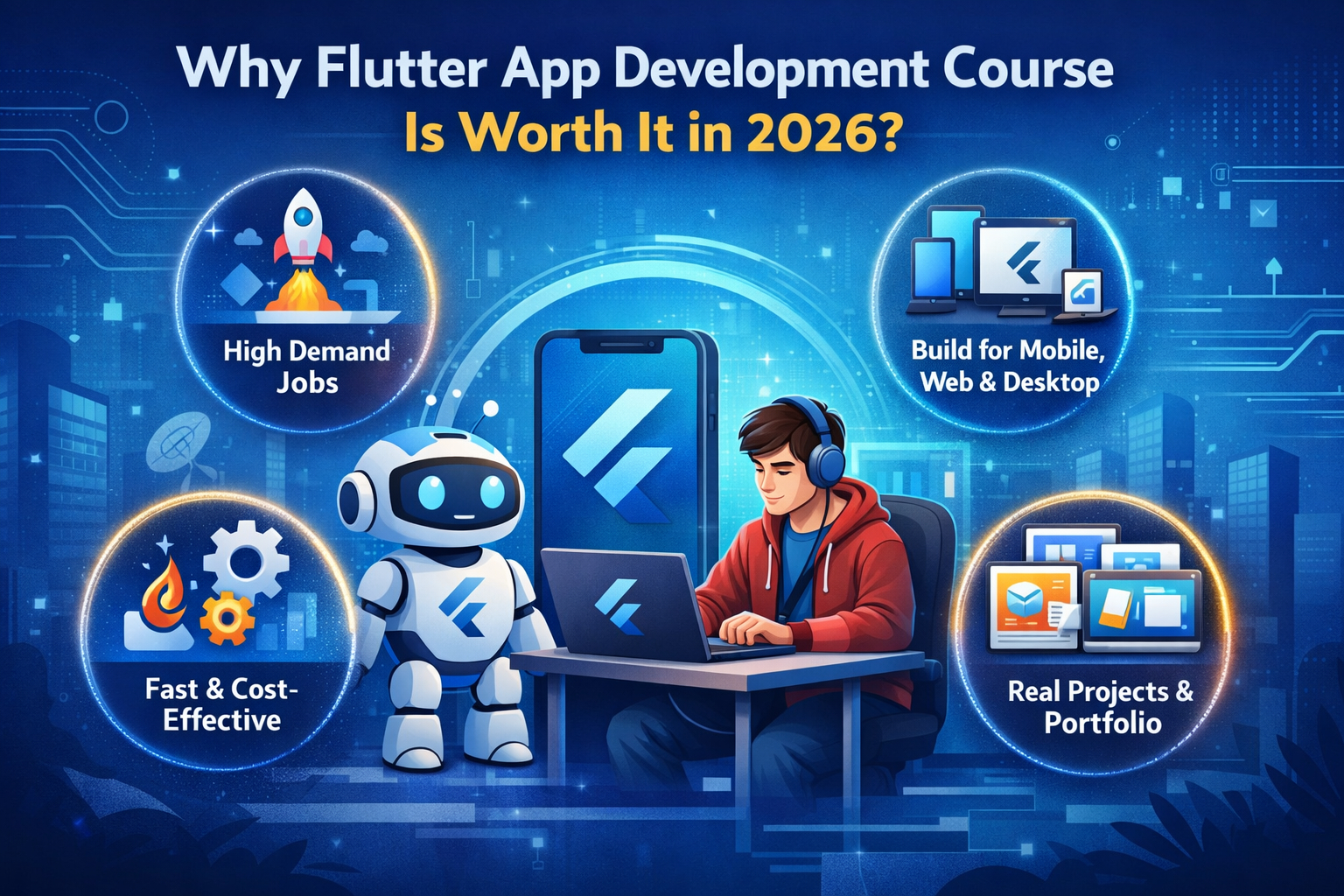
With the rise of cross-platform app development, businesses are actively seeking developers who can build apps for both Android and iOS without maintaining separate teams. Flutter fulfills this requirement perfectly, making Flutter developers highly sought after.
In 2026, industries such as:
- E-commerce
- FinTech
- Healthcare
- EdTech
- Travel & Hospitality
- On-demand services
are increasingly relying on Flutter for scalable app solutions.
Global Career Opportunities
Choosing a Flutter app development course in 2026 opens doors to global job opportunities, including:
- Flutter App Developer
- Mobile Application Engineer
- Cross-Platform Developer
- UI/UX-focused Mobile Developer
- Freelance Flutter Consultant
Remote work opportunities are also abundant, as Flutter allows developers to collaborate efficiently across borders.
Why Choose a Flutter App Development Course in 2026?
One Codebase, Multiple Platforms
One of Flutter’s biggest advantages is the single codebase approach. A Flutter app development course teaches you how to create apps that run seamlessly on:
- Android
- iOS
- Web
- Windows
- macOS
- Linux
This significantly reduces development time and effort, making you more productive as a developer.
High Performance and Native Feel
Flutter compiles directly to native ARM code and uses its own rendering engine, ensuring:
- Smooth animations
- Fast app performance
- Native-like user experience
Learning Flutter in 2026 means mastering a framework that delivers performance comparable to native apps.
Fast Development with Hot Reload
Flutter’s Hot Reload feature allows developers to see changes instantly without restarting the app. This boosts productivity and accelerates learning during a Flutter app development course.
Students can experiment, fix bugs, and refine UI designs in real time.
Growing Ecosystem and Community Support
By 2026, Flutter’s ecosystem includes:
- Thousands of open-source packages
- Extensive documentation
- Active developer communities
- Regular Google-backed updates
A Flutter app development course gives learners access to best practices, community resources, and real-world development workflows.
Flutter vs Other Mobile Development Frameworks
Flutter vs Native Development
While native development requires separate codebases for Android (Kotlin/Java) and iOS (Swift), Flutter enables:
- Faster development cycles
- Reduced cost
- Consistent UI
In 2026, businesses prefer Flutter to optimize resources and scale efficiently.
Flutter vs React Native
Although React Native remains popular, Flutter offers:
- Better UI consistency
- Improved performance
- Fewer third-party dependencies
This makes Flutter a preferred choice for long-term projects.
Career Growth After a Flutter App Development Course
High-Paying Job Roles
Completing a Flutter app development course in 2026 can lead to lucrative roles such as:
- Senior Flutter Developer
- Mobile App Architect
- Technical Lead
- Startup Co-founder
Flutter skills are especially valuable for startups seeking fast MVP development.
Freelancing and Startup Opportunities
Flutter is ideal for freelancers due to:
- Rapid development
- Wide client demand
- Cross-platform delivery
Many entrepreneurs choose Flutter to build and launch their products quickly.
What You Learn in a Flutter App Development Course?
A comprehensive Flutter app development course in 2026 typically covers:
- Dart programming fundamentals
- Flutter widgets and UI design
- State management techniques
- API integration
- Database and backend connectivity
- App testing and debugging
- App deployment on Play Store and App Store
These skills prepare learners for real-world app development challenges.
Flutter for Future Technologies
Integration with AI and IoT
Flutter apps can easily integrate with:
- Artificial Intelligence APIs
- Machine Learning models
- IoT devices
This makes Flutter a future-ready technology in 2026 and beyond.
Flutter for Web and Desktop
Flutter’s expansion beyond mobile allows developers to build:
- Progressive Web Apps (PWAs)
- Desktop applications
A Flutter app development course equips learners with multi-platform expertise.
Why Flutter Is Ideal for Beginners and Professionals?
Flutter’s intuitive design, clear documentation, and visual approach make it suitable for:
- Beginners entering app development
- Experienced developers switching frameworks
- Designers interested in UI-centric development
Learning Flutter in 2026 is a strategic step regardless of your experience level.
The Role of Flutter in Business and Startups
Businesses prefer Flutter because it:
- Reduces development costs
- Speeds up product launches
- Ensures consistent branding
- Simplifies maintenance
Startups in 2026 increasingly choose Flutter to gain a competitive edge.
Why 2026 Is the Right Time to Learn Flutter?
Several factors make 2026 the ideal year to enroll in a Flutter app development course:
- Maturity of the framework
- Stable ecosystem
- Strong industry demand
- High return on learning investment
Flutter is no longer experimental—it is a proven, enterprise-ready solution.
Future Scope of Flutter App Development
The future of Flutter looks promising with:
- Continuous updates from Google
- Expansion into new platforms
- Growing enterprise adoption
- Rising developer salaries
A Flutter app development course in 2026 ensures long-term career stability.
Conclusion
Choosing a Flutter app development course in 2026 is a smart and future-oriented decision for anyone looking to build a successful career in mobile app development. Flutter’s ability to deliver high-performance, visually stunning, and cross-platform applications makes it one of the most in-demand technologies in the software industry.
Whether you are a student, working professional, freelancer, or entrepreneur, learning Flutter equips you with versatile skills that align with industry needs and future trends. As businesses continue to embrace cross-platform solutions, Flutter developers will remain at the forefront of innovation.
If you’re planning to invest in a technology that offers career growth, global opportunities, and long-term relevance, Flutter is undoubtedly the right choice in 2026.
Frequently Asked Questions (FAQs)
Is Flutter worth learning in 2026?
Yes, Flutter is worth learning in 2026 due to its high demand, cross-platform capabilities, and strong industry adoption.
Who should take a Flutter app development course?
Students, beginners, working professionals, freelancers, and startup founders can all benefit from learning Flutter.
What will I learn in a Flutter app development course?
You will learn Dart, Flutter UI, state management, API integration, testing, and app deployment.
Are Flutter developers in demand in 2026?
Yes, Flutter developers are in high demand as companies prefer faster and cost-effective cross-platform development.
How long does it take to learn Flutter?
Most learners can understand Flutter basics within 2–3 months with regular practice.
Can Flutter be used for web and desktop apps?
Yes, Flutter supports mobile, web, and desktop app development using a single codebase.