


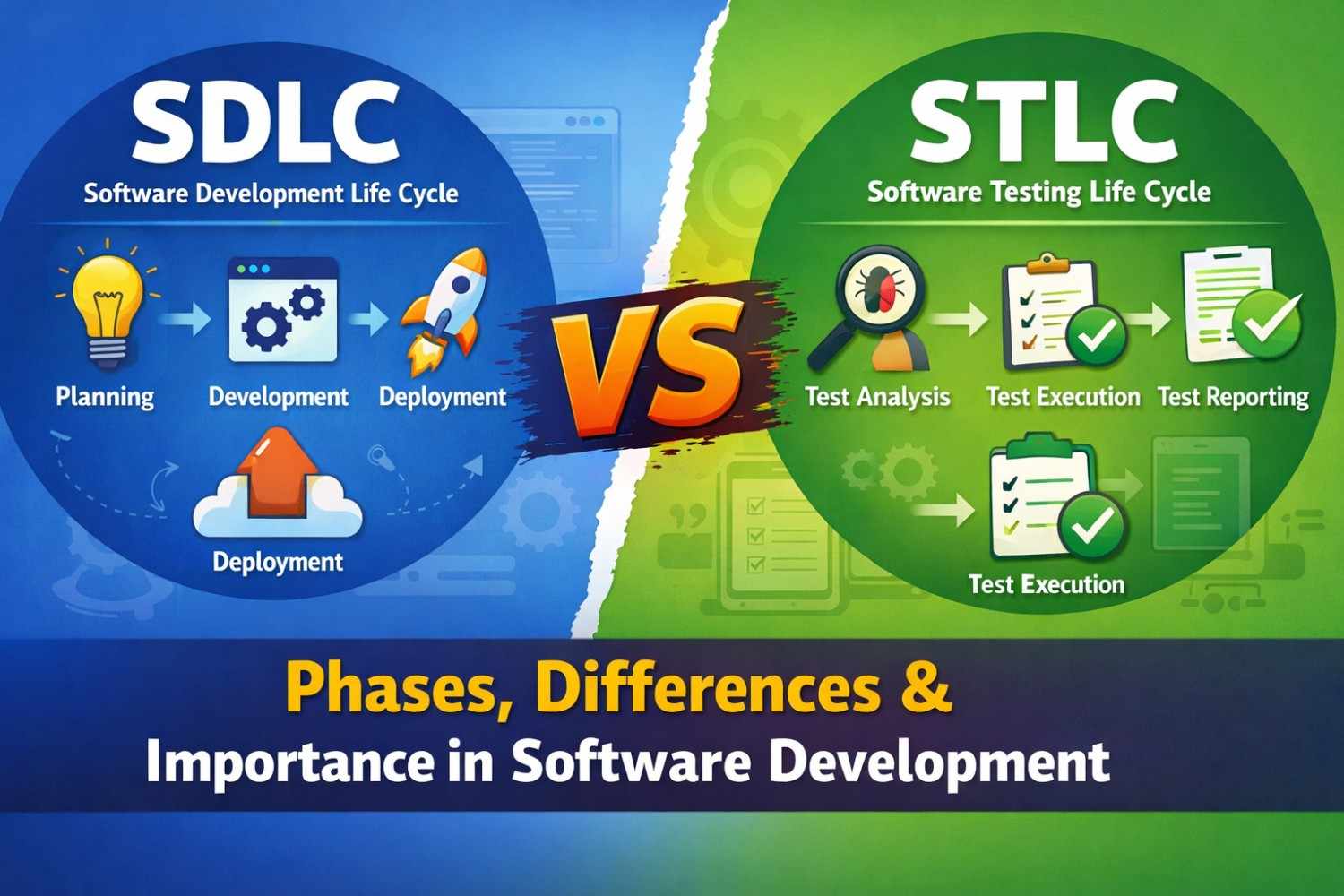
In the world of software development, building a high-quality product requires both development planning and proper testing processes. Two important concepts that every aspiring developer or Quality Analyst (QA) should understand are SDLC (Software Development Life Cycle) and STLC (Software Testing Life Cycle).
If you are planning to start a career in software testing or development, understanding these two lifecycles is essential.
Let’s break them down in simple terms.
What is SDLC (Software Development Life Cycle)?
The Software Development Life Cycle (SDLC) is a structured process used by development teams to design, build, test, and deliver software applications.
It ensures that software is developed systematically, efficiently, and with minimal errors.
Phases of SDLC
Here are the main stages of SDLC:
1. Requirement Analysis
In this phase, business requirements are gathered and documented. The team understands what the software should do.
2. Planning
Project scope, timelines, cost estimation, and resource planning are defined.
3. Design
System architecture, database design, and UI/UX structure are created.
4. Development
Developers start writing the actual code based on the design documents.
5. Testing
The QA team tests the software to identify bugs and ensure functionality.
6. Deployment
The application is released to users.
7. Maintenance
Bug fixes, updates, and improvements are handled after release.
What is STLC (Software Testing Life Cycle)?
The Software Testing Life Cycle (STLC) focuses specifically on the testing process within the SDLC. It defines the steps QA professionals follow to ensure software quality.
STLC helps testers perform organized, efficient, and complete testing.
Phases of STLC
1. Requirement Analysis
Testers review the requirements and identify what needs to be tested.
2. Test Planning
The QA team prepares a testing strategy, tools, timelines, and effort estimation.
3. Test Case Development
Test cases, scenarios, and test data are created.
4. Test Environment Setup
The environment required for testing is prepared.
5. Test Execution
Test cases are executed and defects are reported.
6. Test Cycle Closure
Testing results are documented, and reports are shared.
SDLC vs STLC: Key Difference
| SDLC | STLC |
|---|---|
| Focuses on software development | Focuses on software testing |
| Includes planning, design, coding, and deployment | Includes test planning, execution, and reporting |
| Managed by developers and project managers | Managed by QA engineers and testers |
| Covers the complete product lifecycle | Covers the testing lifecycle |
In simple terms, SDLC builds the product, while STLC ensures the product works correctly.
Why Should Students Learn SDLC and STLC?
Understanding SDLC and STLC is important because:
-
It helps you understand how software projects work
-
It prepares you for QA and developer job roles
-
It improves testing and debugging skills
-
It builds industry-ready knowledge
-
It is commonly asked in technical interviews
Whether you want to become a Quality Analyst, Software Tester, or Developer, these concepts form the foundation of software engineering.
Real-World Example
Imagine a company building a food delivery app.
-
The SDLC defines how the app will be planned, designed, coded, and launched.
-
The STLC ensures features like login, ordering, and payments work properly without bugs.
Both processes work together to deliver reliable software.
Final Thoughts
SDLC and STLC are fundamental concepts in software development and testing. They help teams build high-quality, reliable, and user-friendly applications.
For students who want to start a career in Quality Assurance or Software Testing, learning these lifecycles is the first step toward becoming job-ready.
At Synarion Academy, students learn SDLC, STLC, defect management, test case design, and real-world testing practices through hands-on training and live projects.