


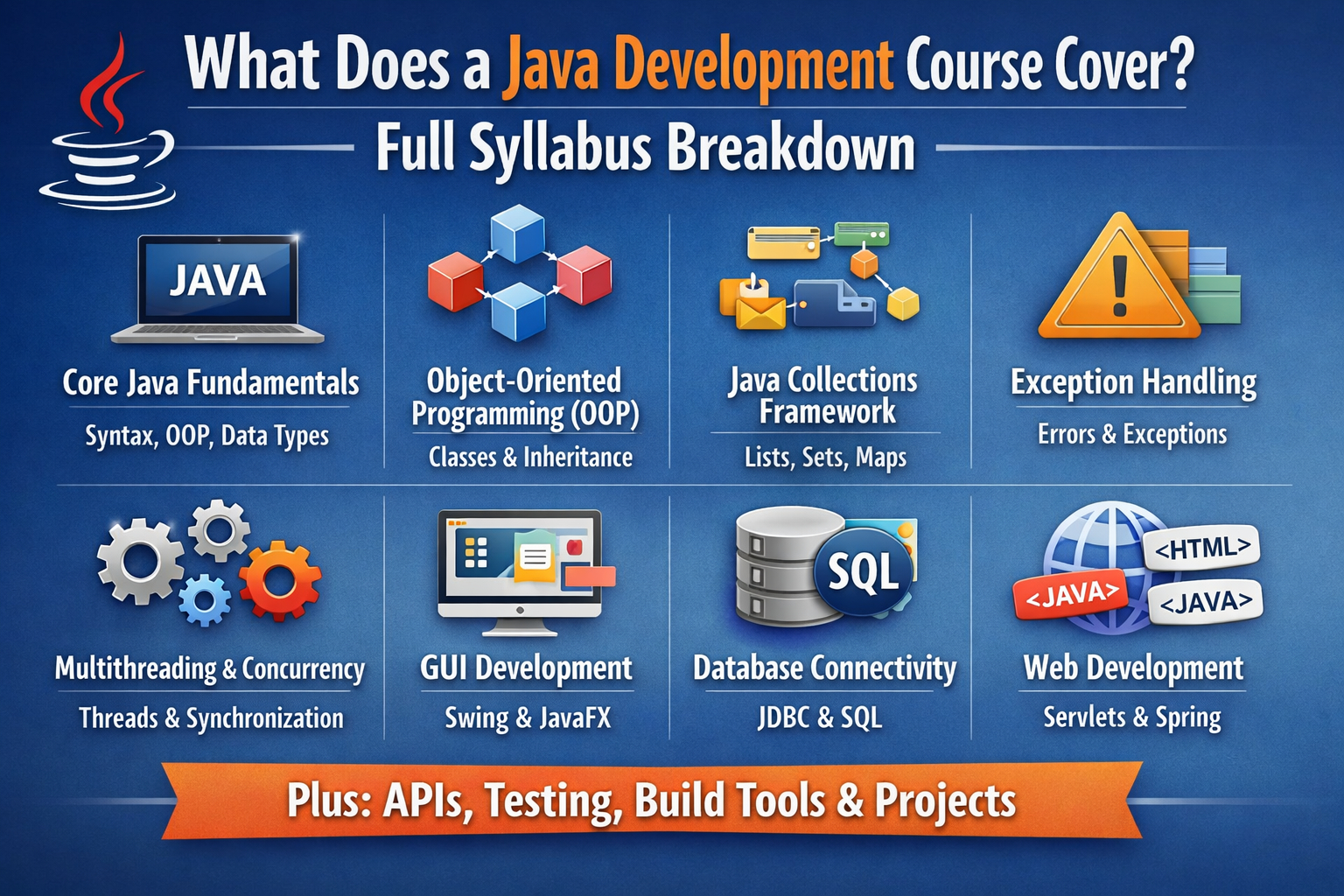
Java has remained one of the most in-demand programming languages for decades, powering everything from enterprise software and web applications to mobile apps and cloud platforms. If you are planning to build a career in software development, enrolling in a Java Development Course is a smart and future-proof decision.
This detailed guide explains what you will learn in a Java Development course, covering everything from core programming fundamentals to advanced frameworks, real-world projects, and career preparation. Whether you are a beginner or someone looking to upgrade skills, this syllabus breakdown will help you understand exactly what to expect.
Introduction to Java and Object-Oriented Programming (OOP)
A Java Development course usually begins with a strong foundation in Java basics and Object-Oriented Programming concepts. You will learn why Java is platform-independent, how the Java Virtual Machine (JVM) works, and where Java is used in real-world applications.
Key topics include:
- Introduction to Java programming language
- Java history and ecosystem
- Understanding JVM, JRE, and JDK
- Writing your first Java program
Object-Oriented Programming (OOP) concepts form the backbone of Java. You’ll gain hands-on experience with encapsulation, inheritance, polymorphism, and abstraction, which are essential for building scalable and maintainable applications.
Java Installation and IDE Setup
Before diving deeper, you’ll learn how to install Java and configure development environments. Most Java Development courses train you to work with industry-standard IDEs such as Eclipse and IntelliJ IDEA.
You will learn:
- Installing Java JDK
- Setting environment variables
- Configuring Eclipse and IntelliJ
- Running and debugging Java programs
This setup ensures you are comfortable with professional tools used in real software development environments.
Variables, Data Types, and Operators
This module focuses on Java’s core building blocks. You’ll understand how data is stored and manipulated within programs.
Topics covered include:
- Primitive and non-primitive data types
- Variables and constants
- Type casting
- Arithmetic, relational, logical, and bitwise operators
Mastering these concepts is crucial for writing efficient and error-free Java code.
Control Structures and Flow Statements
A Java Development course teaches how to control the flow of execution in programs using conditional and looping statements.
You will learn:
- If-else conditions
- Switch statements
- For, while, and do-while loops
- Break and continue statements
These concepts help you implement business logic and decision-making in applications.
Functions and Methods in Java
Functions, known as methods in Java, allow developers to write reusable and modular code. This module focuses on method creation and usage.
Key concepts include:
- Method declaration and calling
- Parameters and return types
- Method overloading
- Static vs non-static methods
Understanding methods is essential for organizing code efficiently in large applications.
Arrays, Strings, and Collections Framework
Handling data efficiently is a major part of software development. This module teaches you how to store and manage collections of data.
You will learn:
- One-dimensional and multi-dimensional arrays
- String handling and StringBuilder
- Java Collections Framework (List, Set, Map)
- ArrayList, HashMap, HashSet
These concepts are widely used in real-world Java applications.
Exception Handling in Java
Errors and unexpected situations are inevitable in applications. A Java Development course teaches how to handle them gracefully using exception handling.
Topics include:
- Types of exceptions
- Try-catch-finally blocks
- Custom exceptions
- Checked vs unchecked exceptions
This helps you build robust applications that don’t crash unexpectedly.
File Handling and I/O Streams
You’ll learn how Java handles input and output operations, including reading from and writing to files.
Key topics include:
- File class
- Byte and character streams
- BufferedReader and BufferedWriter
- Serialization and deserialization
These skills are essential for working with data storage and processing.
Multithreading and Concurrency
Modern applications need to perform multiple tasks simultaneously. This module introduces multithreading and concurrency in Java.
You will learn:
- Thread lifecycle
- Creating threads using Thread class and Runnable interface
- Synchronization
- Executor framework
Multithreading knowledge is critical for building high-performance applications.
Java Packages and Access Modifiers
To manage large projects, Java provides packages and access control mechanisms.
This module covers:
- Creating and using packages
- Public, private, protected, and default access modifiers
- Encapsulation best practices
These concepts help maintain clean and secure codebases.
JDBC and Database Connectivity
Almost all real-world applications interact with databases. A Java Development course teaches JDBC (Java Database Connectivity) to connect Java applications with databases like MySQL.
You will learn:
- JDBC architecture
- Connecting Java with MySQL
- CRUD operations using JDBC
- Prepared statements
This module bridges Java applications with backend databases.
Java Servlets and JSP for Web Development
Before moving to modern frameworks, you’ll understand core web technologies like Servlets and JSP.
Key topics include:
- Servlet lifecycle
- Handling HTTP requests and responses
- JSP scripting elements
- MVC architecture basics
This provides a solid foundation for web application development.
Introduction to Spring Framework
Spring is one of the most powerful frameworks in the Java ecosystem. This module introduces Spring Core concepts.
You will learn:
- Dependency Injection (DI)
- Inversion of Control (IoC)
- Spring Beans and configuration
Spring simplifies Java development and improves application scalability.
Spring Boot Fundamentals
Spring Boot makes application development faster and easier. This module is one of the most important parts of a Java Development course.
Topics include:
- Spring Boot architecture
- Auto-configuration
- Creating RESTful APIs
- Application properties
Spring Boot is widely used in enterprise and startup environments.
RESTful API Development with Spring Boot
Modern applications rely heavily on APIs. You’ll learn how to build RESTful APIs using Spring Boot.
Key concepts include:
- HTTP methods (GET, POST, PUT, DELETE)
- JSON data handling
- Request mapping and controllers
- API testing using Postman
This skill is crucial for backend development roles.
Hibernate ORM and JPA Integration
Hibernate simplifies database operations by mapping Java objects to database tables.
You will learn:
- ORM concepts
- Hibernate architecture
- JPA annotations
- Entity relationships
Hibernate is widely used in enterprise-level Java applications.
Security in Java Applications
Security is a critical part of modern development. This module focuses on Spring Security and JWT.
Topics include:
- Authentication and authorization
- Role-based access control
- JWT token-based security
- Securing REST APIs
This ensures your applications are safe from unauthorized access.
Build Tools: Maven and Gradle
Build automation tools help manage dependencies and streamline development.
You will learn:
- Maven project structure
- Dependency management
- Gradle basics
- Build and deployment automation
These tools are essential in professional development environments.
Testing with JUnit and Mockito
Testing ensures application reliability. This module introduces unit testing in Java.
You’ll learn:
- Writing test cases using JUnit
- Mocking dependencies with Mockito
- Test-driven development basics
Testing skills improve code quality and maintainability.
CI/CD Integration and Deployment
A Java Development course also introduces CI/CD pipelines and deployment strategies.
Topics include:
- Jenkins basics
- Docker fundamentals
- Application deployment on AWS and Heroku
This prepares you for DevOps-friendly environments.
Git and Version Control
Version control is essential for collaboration.
You will learn:
- Git basics
- GitHub repositories
- Branching and merging
- Collaborative workflows
These skills are mandatory in real-world projects.
Capstone Project: Enterprise Java Application
Most courses include a capstone project, where you apply everything you’ve learned.
You will:
- Build a real-world Java application
- Implement backend logic and APIs
- Use databases and security
- Deploy the application
This project strengthens your portfolio.
Agile, Freelancing, and Career Preparation
The final stage focuses on career readiness.
Topics include:
- Agile and Scrum basics
- Client project handling
- Resume and portfolio building
- Interview preparation
This helps you confidently step into the job market.
Final Thoughts
A Java Development course offers a complete learning journey—from programming basics to enterprise-level application development. By mastering Java, Spring Boot, databases, APIs, and deployment, you become job-ready for roles like Java Developer, Backend Developer, or Software Engineer. Whether you aim for corporate roles, startups, or freelancing, this syllabus equips you with practical, in-demand skills that unlock long-term career growth.