


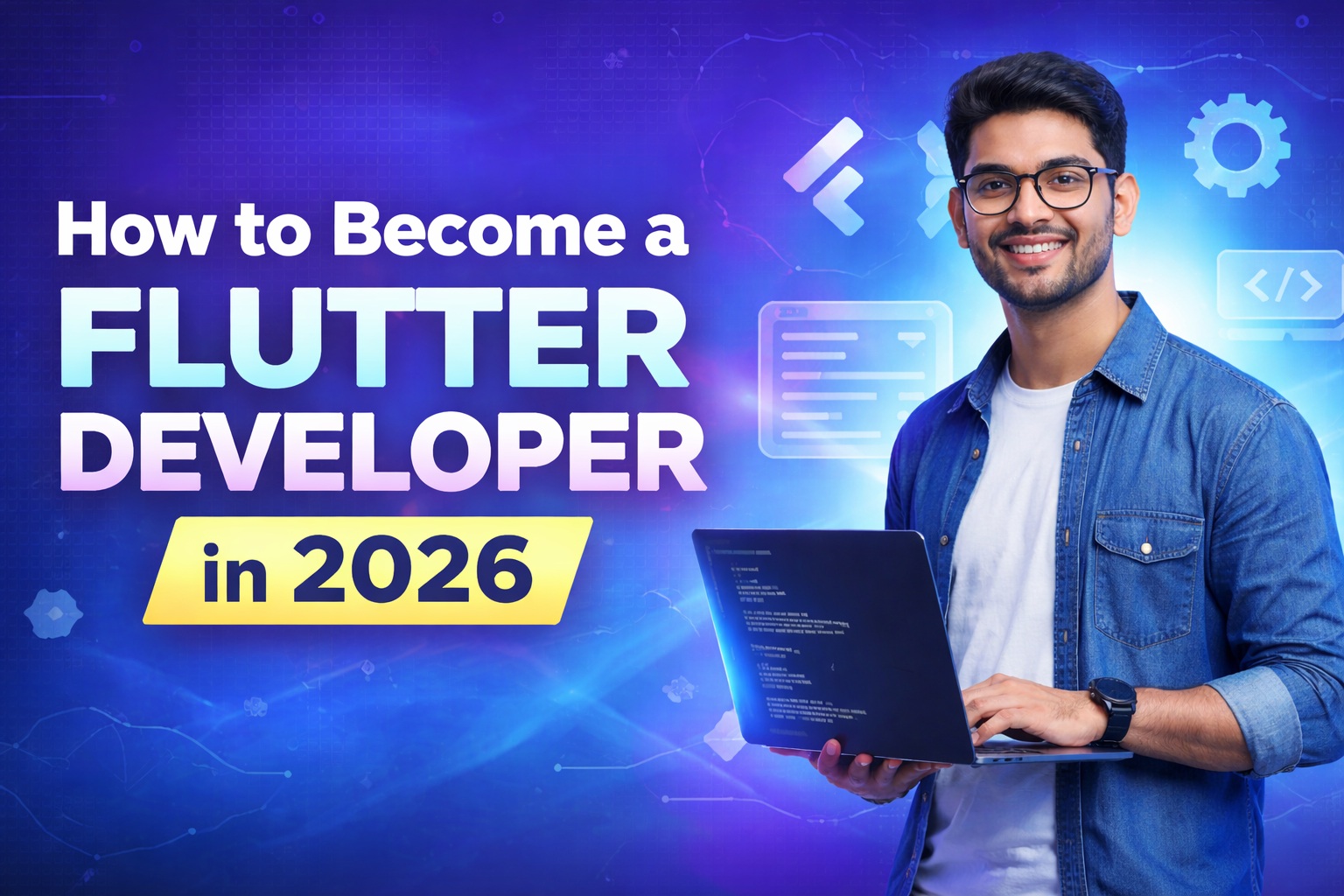
With the rapid growth of mobile apps across industries, Flutter has opened new career opportunities for aspiring developers in India. Backed by Google, Flutter allows developers to create cross-platform apps efficiently and with high performance.
This blog walks you through how to become a Flutter developer in 2026, covering the skills you need to learn, a step-by-step roadmap, and salary insights to help you plan your career with confidence.
What Is Flutter and How Does It Work?
Flutter is an open-source UI software development kit created by Google that allows developers to build high-performance mobile, web, and desktop applications using a single codebase.
Instead of writing separate code for Android and iOS, Flutter enables developers to create one app that works seamlessly across multiple platforms, saving time, cost, and development effort.
Flutter works by using the Dart programming language and a rich set of pre-designed widgets that help developers build visually attractive and responsive user interfaces.
These widgets are highly customizable and adapt to different screen sizes and platforms. Unlike traditional frameworks, Flutter does not rely heavily on platform-specific UI components.
Instead, it uses its own rendering engine to draw the interface directly on the screen, resulting in faster performance and smoother animations.
Another key advantage of Flutter is its hot reload feature, which allows developers to see changes in real time without restarting the application. This makes development faster and more efficient, especially for beginners learning app development.
With strong support from Google, an active developer community, and growing adoption by Indian startups and IT companies, Flutter continues to be a reliable and future-ready technology in 2026.
How to Become a Flutter Developer in 2026
Becoming a Flutter developer in 2026 requires a clear roadmap, practical skills, and hands-on experience. Flutter has grown rapidly in India due to its ability to create cross-platform apps efficiently, making it one of the most sought-after skills for mobile app developers.
To start your journey, you need to understand the basics of programming with Dart, master Flutter’s core concepts like widgets, layouts, and navigation, and gain knowledge of state management tools such as Provider, Bloc, or Riverpod.
Additionally, integrating backend services, APIs, and databases is essential to build fully functional apps. By following a structured learning path and working on real-world projects, beginners and professionals can become job-ready Flutter developers with the skills that companies actively demand in 2026.
Learn Dart Programming Basics
Dart is the programming language behind Flutter, created by Google. Before you can build apps with Flutter, it’s essential to understand Dart, as all Flutter apps are written using it.
Dart is beginner-friendly and easy to learn, especially if you have some prior programming knowledge, but even complete beginners can pick it up quickly.
Key Concepts to Learn in Dart:
- Variables and Data Types – Understand how to store information using strings, integers, doubles, booleans, and lists.
- Functions & Methods – Learn how to write reusable blocks of code to perform specific tasks.
- Control Flow – Get comfortable with if-else statements, loops, and switch cases to control how your app behaves.
- Object-Oriented Programming (OOP) – Flutter heavily relies on OOP, so understanding classes, objects, inheritance, and constructors is crucial.
- Collections & Data Structures – Learn lists, maps, and sets to handle multiple pieces of data efficiently.
- Asynchronous Programming – Understand Futures, async, and await to handle tasks like API calls or database access without freezing your app.
Understand Flutter Widgets & UI Design
In Flutter, everything you see on the screen is a widget. Widgets are the basic building blocks of a Flutter app, whether it’s a button, text, image, or even a complex layout. Understanding widgets and how they work is essential to create visually appealing and responsive mobile applications.
Key Concepts to Learn:
- Stateless vs Stateful Widgets
- Stateless Widgets: Do not change once created (e.g., Text, Icon).
- Stateful Widgets: Can change dynamically based on user interaction or app logic (e.g., Checkbox, Slider).
- Layout Widgets
- Organize your UI using widgets like Row, Column, Stack, and Container.
- Learn how padding, margin, and alignment work to create responsive designs.
- Built-in UI Widgets
- Buttons, TextFields, Cards, Lists, Images, Icons, AppBar, BottomNavigationBar, etc.
- Understand how to customize their appearance and behavior.
- Themes and Styling
- Use ThemeData to maintain consistent colors, fonts, and styles across your app.
- Learn to use MaterialApp and CupertinoApp for Android and iOS-specific designs.
- Interactive Widgets
- Learn widgets that respond to user input like GestureDetector, InkWell, and form fields.
Master State Management
State management is one of the most crucial concepts in Flutter development. In simple terms, “state” represents the data or information that can change in your app—like user input, API responses, or the current screen content. Managing state effectively ensures that your app responds correctly to user actions and updates the UI in real-time.
Key Concepts to Learn:
- Local State Management
- setState(): The simplest way to update the UI in Flutter for small apps or individual widgets.
- Use it to manage temporary changes within a single widget.
- App-Level State Management
For larger apps, you need tools that can manage data across multiple screens:- Provider: A beginner-friendly solution for managing app-wide state.
- Bloc (Business Logic Component): Helps separate UI from business logic for cleaner, scalable code.
- Riverpod: A modern alternative to Provider with more flexibility and better performance.
- GetX: Lightweight solution for both state management and navigation.
- Why State Management Matters
- Keeps your app predictable and maintainable.
- Ensures UI updates correctly when data changes.
- Helps avoid bugs in large, complex applications.
Practical Tips:
- Start with setState() to understand basic reactivity.
- Move to Provider for small-to-medium apps.
- Explore Bloc or Riverpod when building professional apps or preparing for a career in Flutter development.
Work with APIs & Backend Services
Building a fully functional Flutter app requires connecting it to backend services and APIs to fetch, send, and store data. APIs (Application Programming Interfaces) allow your app to communicate with external services such as databases, cloud servers, or third-party applications, making your app dynamic and interactive.
Key Concepts to Learn:
- Understanding REST APIs
- REST (Representational State Transfer) APIs are the most common way apps exchange data over the internet.
- Learn how to make HTTP requests using Flutter’s http package.
- Practice fetching data (GET requests) and sending data (POST requests) to and from APIs.
- JSON Parsing
- Most APIs send data in JSON format.
- Learn how to parse JSON into Dart objects and display the data in your Flutter app.
- Firebase Integration
- Firebase is a popular backend-as-a-service (BaaS) platform widely used with Flutter.
- Features to focus on:
- Firestore (Real-time database)
- Authentication (Email, Google, Social logins)
- Cloud Functions
- Push Notifications
- Database Connectivity
- Learn local storage options like SharedPreferences and SQLite for offline functionality.
- Understand when to use cloud databases versus local storage.
- Authentication & Security
- Implement secure login and registration using APIs.
- Learn token-based authentication for user sessions.
Build Real-World Projects
After learning the fundamentals of Flutter, Dart, state management, and backend integration, the next crucial step is to apply your knowledge by building real-world projects. Practical experience is what makes you a job-ready Flutter developer and helps you stand out to employers or clients.
Key Projects to Start With:
- E-commerce App
- Create a simple online store with product listings, shopping cart, and checkout functionality.
- Integrate APIs for product data and payments.
- Focus on UI design, smooth navigation, and state management.
- Chat Application
- Build a messaging app with real-time chat functionality.
- Use Firebase for authentication and database storage.
- Implement features like notifications, emojis, and online/offline status.
- To-Do / Productivity App
- A lightweight project to practice CRUD operations (Create, Read, Update, Delete).
- Learn how to store tasks locally or in the cloud.
- Focus on clean UI and user-friendly experience.
- Admin Dashboard
- Build an app to manage users, orders, or analytics data.
- Practice integrating charts, graphs, and responsive layouts.
- Useful for understanding complex real-world app scenarios.
Prepare Your Portfolio & Resume
After mastering Flutter skills and building real-world projects, the next critical step is to showcase your expertise through a professional portfolio and resume. A strong portfolio not only highlights your technical abilities but also demonstrates your practical experience to potential employers or clients.
Key Tips for Your Portfolio:
- Showcase Your Projects
- Include 3–5 of your best Flutter projects with screenshots, descriptions, and links (if hosted).
- Highlight the technologies used, challenges faced, and solutions implemented.
- Highlight Skills & Technologies
- Clearly mention your proficiency in Dart, Flutter, state management tools (Provider, Bloc, Riverpod), API integration, Firebase, and UI design.
- Include any certifications or courses completed, like those from Synarion Academy.
- Demonstrate Problem-Solving
- Explain the problems your app solves and how users benefit from it.
- Employers value developers who understand the why behind their work, not just the how.
- Keep It Clean and Professional
- Use a simple website or PDF format for your portfolio.
- Organize projects in a structured way with easy navigation.
Resume Tips:
- Tailor your resume for Flutter developer roles in India.
- Mention your hands-on experience, projects, internships, and freelance work.
- Include keywords like “Flutter Development,” “Dart Programming,” “Cross-Platform App Development,” and “Firebase Integration” to match job descriptions.
- Keep it concise (1–2 pages) and highlight measurable outcomes (e.g., “Built e-commerce app with 100+ products and integrated payment gateway”).
Flutter Developer Salary & Career Opportunities in India (2026)
As the demand for cross‑platform mobile applications continues to rise, Flutter developers are increasingly sought after by startups, tech companies, and enterprise clients across India. In 2026, Flutter development will remain one of the fastest‑growing career paths in the software industry, thanks to its ability to deliver high‑performance apps with a single codebase for both Android and iOS platforms.
Career Opportunities for Flutter Developers
Flutter developers can explore a variety of roles in India, such as:
- Junior Flutter Developer – Ideal for freshers and beginners
- Flutter App Developer – Building full applications with UI/UX components
- Mobile App Engineer – Focusing on cross‑platform solutions
- Full‑Stack Developer (Flutter + Backend) – Handling both front‑end and server‑side logic
- Freelance Flutter Developer – Working with clients globally
- Flutter Consultant/Trainer – Teaching or mentoring others in Flutter
Many organizations—especially tech startups, digital product agencies, and software service companies—prefer developers who can build reliable, scalable apps with clean code and modern design principles. With strong project experience and a solid portfolio, developers can also work as independent freelancers, offering services on platforms like Upwork, Freelancer, and Toptal.
Flutter Developer Salary in India (2026)
While exact figures can vary based on city, experience, and company size, here’s a general idea of salary expectations for Flutter developers in India in 2026:
Final Words
Becoming a Flutter developer in 2026 is more than learning a framework—it’s about building a future-proof career. By mastering Dart, Flutter widgets, state management, and backend integration, and applying these skills in real-world projects, you position yourself as a job-ready professional. Practical training and hands-on experience make the difference between theory and real-world success. With dedication and the right roadmap, you can launch a rewarding career in mobile app development and tap into India’s growing demand for skilled Flutter developers.