


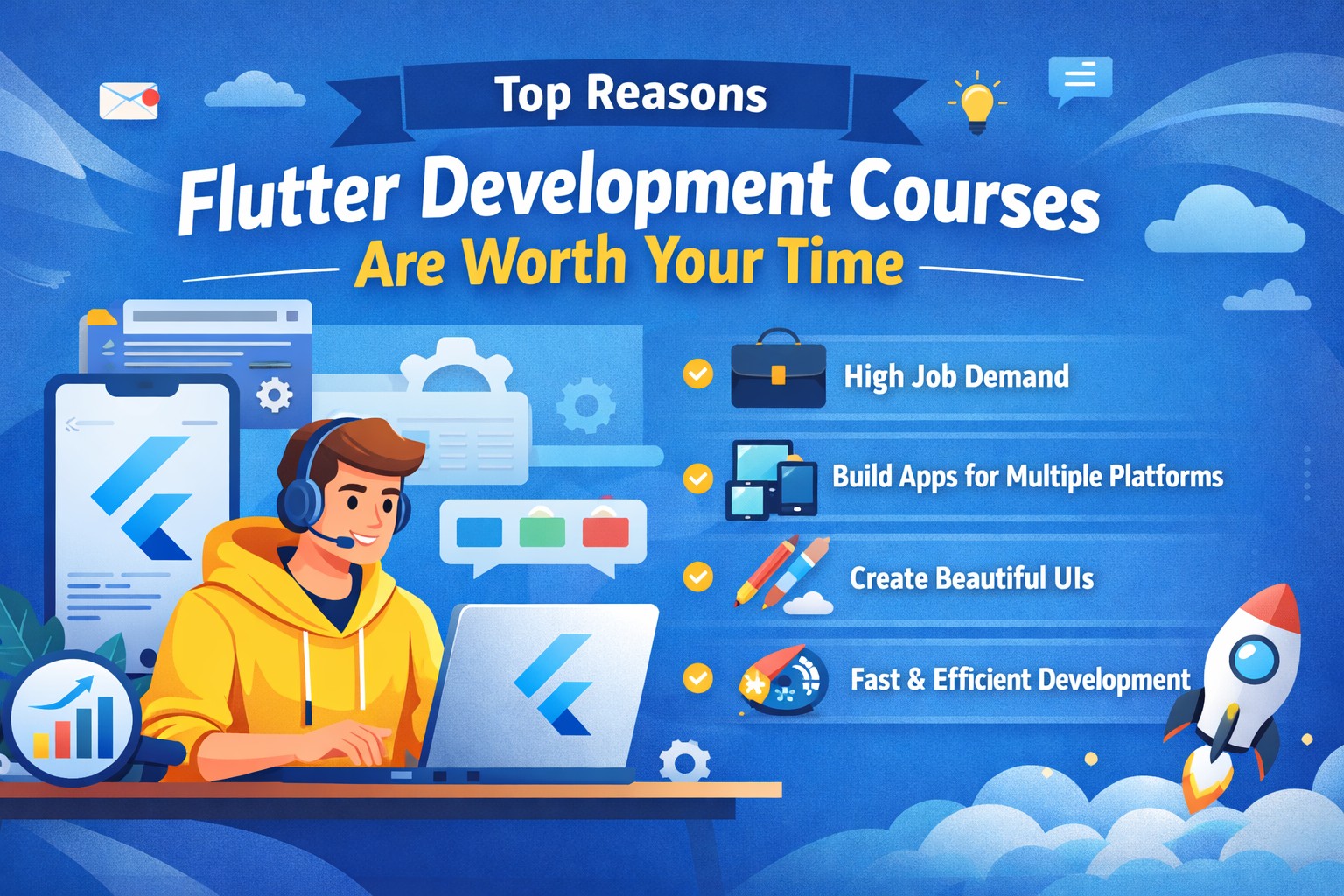
In the rapidly evolving world of mobile and web development, choosing the right technology stack can make or break your career or business. Among the many options available today, Flutter stands out as a powerful and versatile framework that has redefined the way developers build cross-platform applications. Created by Google, Flutter enables developers to build beautiful, natively compiled applications for mobile, web, and desktop—all from a single codebase. Enrolling in a Flutter App Development Course can help you master this framework, gain hands-on experience, and accelerate your journey toward becoming a skilled cross-platform developer.
Whether you are a student exploring career options, a developer seeking to upgrade your skills, an entrepreneur planning to build an app, or a business owner aiming for digital transformation, enrolling in a Flutter App Development Course could be one of the best decisions you make. In this comprehensive blog post, we’ll explore the top reasons to enroll in a Flutter App Development Course and how it can accelerate your career and open new opportunities.
Flutter Is Changing the App Development Landscape
Flutter has emerged as one of the most promising frameworks for cross-platform app development. Unlike traditional native development, which requires building separate apps for Android and iOS, Flutter allows developers to:
- Write a single codebase for multiple platforms
- Reduce development time and cost
- Maintain consistency across devices
This shift toward cross-platform development reflects industry demand for efficient and scalable solutions. Companies across the globe are increasingly adopting Flutter to build robust, high-performance applications, making expertise in this framework a highly sought-after skill.
By enrolling in a Flutter app development course, you’ll stay ahead of the curve and position yourself as a developer who understands modern app development trends.
High Demand for Flutter Developers in Job Markets
The demand for skilled Flutter developers has grown exponentially. With more businesses seeking versatile and budget-friendly solutions, Flutter expertise is now one of the most valuable skills in the IT job market.
Reasons for High Demand:
- Businesses want faster time-to-market
- Startups prefer a single team to build multiple platform apps
- Companies want to reduce development costs without compromising quality
As a result, companies are actively hiring Flutter developers for roles such as:
- Flutter Developer
- Front-End Developer (Flutter)
- Full-Stack Developer (Flutter & Backend Framework)
- UI/UX Specialist for Flutter applications
Whether you’re targeting full-time employment, freelancing opportunities, or remote gigs, mastering Flutter dramatically enhances your employability and earning potential.
Build Cross-Platform Apps with a Single Codebase
One of Flutter’s greatest advantages is its ability to support cross-platform development. With Flutter, you can write one codebase that works seamlessly on:
- Android
- iOS
- Web browsers
- Desktop platforms (Windows, macOS, Linux)
This capability is a game-changer for developers and businesses alike. It simplifies the development process and keeps the app’s design consistent across different platforms.
A Flutter App Development Course teaches you how to:
- Structure a clean and scalable project
- Implement responsive UI for different screen sizes
- Optimize app performance for various platforms
- Debug and test across devices
This multi-platform expertise not only boosts your technical capabilities but also makes you more valuable in any development team.
Fast Development with Hot Reload
One of the most talked-about features of Flutter is Hot Reload.
Hot Reload allows developers to instantly view the results of code changes without restarting the app. This significantly speeds up the development cycle by:
- Reducing debugging time
- Enhancing experimentation
- Improving productivity
When you enroll in a Flutter App Development Course, you’ll learn how to leverage Hot Reload effectively to boost your workflow and save valuable time during development.
Rich and Beautiful UI with Widget-Based Architecture
Flutter uses a widget-based architecture, giving developers full control over every pixel on the screen. This empowers you to design expressive and visually stunning user interfaces.
Unlike other frameworks that depend on platform-specific UI elements, Flutter renders everything using a rich set of customizable widgets. This ensures:
- Smooth animations
- Consistent UI across platforms
- Easy implementation of complex layouts
A professional Flutter App Development Course will walk you through:
- Basic to advanced widgets
- Custom widget creation
- Animation and transitions
- Material Design & Cupertino Widgets
Whether you are passionate about UI/UX or simply want to create aesthetically pleasing apps, Flutter provides the tools—and the course will teach you how to use them.
Excellent Performance
Performance is a key factor in user satisfaction, and Flutter delivers exceptionally well in this aspect.
Unlike hybrid frameworks that rely on WebView, Flutter compiles directly to native ARM code. This means:
- Faster app startup time
- Smooth animations at 60fps (or even 120fps)
- Near-native performance on both Android and iOS
A Flutter App Development Course will help you understand how:
- Dart (Flutter’s programming language) works under the hood
- Flutter builds native binaries
- You can optimize app performance for real-world use
Better performance leads to happier users—and that’s what every developer and business owner ultimately wants.
Backed by Google and a Growing Community
One of the biggest comfort factors for developers choosing a framework is support and stability. Flutter is officially supported by Google, which continuously updates and improves the framework. Google uses Flutter internally for products like Google Ads.
Along with corporate support, Flutter has a thriving open-source community. This means:
- Lots of reusable packages and plugins
- Community-driven tutorials, courses, and templates
- Quick solutions for common development issues
In a Flutter course, you’ll get exposure to:
- The official Flutter ecosystem
- How to use community packages
- Best practices adopted by thousands of developers worldwide
Being part of a strong developer community ensures that you never feel stuck or isolated while learning or building apps.
Great for Freelancers and Entrepreneurs
If you’re a freelancer or entrepreneur, Flutter offers tremendous advantages:
For Freelancers
- Ability to work on multiple projects (Android + iOS + Web)
- Higher earning potential
- Faster delivery leads to more clients
For Entrepreneurs
- Faster product development
- Cost savings on development resources
- Easier iterations and updates
When you enroll in a Flutter course, you gain not just a technical skill but also a business advantage. You’ll learn how to plan, design, and build apps that your customers or clients will love.
Flutter Integrates with Backend Services Easily
Modern applications often need to connect with backend systems for features such as:
- User authentication
- Cloud storage
- Real-time databases
- APIs and third-party services
Flutter integrates smoothly with popular backend services like:
- Firebase
- REST APIs
- GraphQL servers
- AWS and Google Cloud services
A good Flutter course will guide you on how to:
- Connect your app with backend services
- Manage data and user authentication
- Store and retrieve information
- Handle real-time updates
This makes Flutter not just a UI framework, but a complete solution for full-stack app development.
Continuous Updates and Future Growth
Technology evolves quickly, and the tools that survive are the ones that adapt. Flutter is constantly evolving with new features, performance enhancements, and expanded platform support.
With recent updates, Flutter now supports:
- Web development
- Desktop applications
- Embedded systems
This continuous growth means your investment in learning Flutter will pay off for years to come. A course ensures you learn not just current features, but also how to adapt to future changes in the framework.
Strong Portfolio Projects After Course Completion
One of the most valuable outcomes of enrolling in a Flutter course is the portfolio you build. Most courses include real-world projects such as:
- E-commerce apps
- Social media apps
- Chat apps
- Productivity tools
These projects serve as proof of your skills when applying for jobs or pitching to clients. A strong portfolio can set you apart from other developers and boost your chances of success in a competitive landscape.
Learning Dart—A Powerful Modern Language
Flutter uses Dart, a language developed by Google that combines powerful features with simplicity. Dart is:
- Easy to learn for beginners
- Strongly typed
- Optimized for UI development
- Fast and efficient
Learning Dart alongside Flutter equips you with programming fundamentals that apply beyond Flutter. Many concepts you learn in Dart—such as object-oriented programming and asynchronous coding—are skills you’ll use in other languages and frameworks as well.
A good Flutter course will take you from Dart basics to advanced techniques so you become a confident developer.
Support for Testing and Debugging
Great applications are not just written—they are tested. Flutter comes with built-in support for:
- Unit testing
- Widget testing
- Integration testing
A structured course will teach you how to write tests that:
- Ensure app reliability
- Catch bugs early
- Improve app stability
This testing knowledge is essential for professional development and distinguishes experts from beginners.
Opens Doors to Full-Stack and Advanced Roles
Learning Flutter can be a stepping stone to more advanced career paths such as:
- Full-Stack Developer (Flutter + Backend)
- Mobile Architect
- Technical Lead
- Product Manager with Development Expertise
As businesses look for versatile professionals, your combined knowledge of UI, backend integration, performance optimization, and cross-platform strategies can help you rise above traditional roles.
Supportive Learning Resources and Certifications
Finally, enrolling in a Flutter course often comes with:
- Mentorship from experienced instructors
- Structured learning paths
- Assignments and quizzes
- Certificates of completion
Certifications can boost your resume and improve trust with clients and employers. Additionally, structured courses help eliminate confusion, guide your learning, and accelerate your skill development more effectively than self-study alone.
Conclusion
In today’s tech landscape, where innovation never stops and competition continues to grow, choosing the right skill set is essential. Flutter has proven itself as a robust, efficient, and future-ready framework for building high-quality cross-platform applications.
Whether you are a beginner looking for your first career path, an experienced developer seeking to expand your skill set, a freelancer aiming to increase your market value, or an entrepreneur building your next product—enrolling in a Flutter App Development Course is a strategic investment in your future.
FAQs
Who should enroll in a Flutter app development course?
Anyone interested in app development, including beginners, students, working professionals, freelancers, and entrepreneurs, can enroll. Basic programming knowledge is helpful but not mandatory.
Is Flutter suitable for beginners?
Yes, Flutter is beginner-friendly. With its clear documentation, simple Dart language, and widget-based structure, beginners can learn and build apps quickly.
What skills will I gain from a Flutter development course?
You’ll learn Dart programming, cross-platform app development, UI/UX design with widgets, API integration, state management, testing, and app deployment.
What are the career opportunities after learning Flutter?
After completing a Flutter course, you can work as a Flutter developer, mobile app developer, full-stack developer, or freelancer, or build your own apps.
How long does it take to learn Flutter?
With regular practice, you can learn Flutter fundamentals in 6–8 weeks. Advanced concepts and real-world projects may take a few more weeks.
Is Flutter a good choice for future app development?
Yes, Flutter has strong backing from Google, a growing community, and expanding support for mobile, web, and desktop platforms, making it future-ready.